Taking Care Of Your Children Through Good Deeds…

In the name of Allah, most Gracious, most Merciful.

Many of you might be familiar with the story of Musa (A.S) and His encounter with Al-Khidr. For anyone who isn’t, watch this space and Insha Allah I will summarise the story at a later time. There were 3 events that took place on this journey, in summary, they were:

  1. Al-Khidr made a hole in the boat of the men that assisted them to cross the sea
  2. Al-Khidr killed a child
  3. Al-Khidr reinforced a broken wall in a town whose people were selfish and inhospitable
I’d like to focus on the 3rd event that took place as there is a great lesson to be learnt.  Beneath the wall lay a treasure that belonged to 2 orphans, so in order to protect the treasure from the people of the town, Al-Khidr fixed the wall. It was revealed that the reason he was ordered to fix the wall for the orphans was because their father was a righteous man.
“And as for the wall, it belonged to two orphan boys in the city, and there was beneath it a treasure belonging to them, and their father was a righteous man; so your Lord desired that they should attain their maturity and take out their treasure, a mercy from your Lord, and I did not do it of my own accord. This is the significance of that with which you could not have patience.” (Surah al-Kahf)
Sa`id bin Jubayr narrated from Ibn `Abbas: “They were taken care of because their father was a righteous man, although it is not stated that they themselves were righteous.”

In this is a great lesson for parents today. Uphold the commandments of Allah and Allah will take care of your children whether you are with them or not.

Remembering Allah: Alhamdulillah…

In the name of Allah, most Gracious, most Merciful.

Make a habit if saying Alhamdulillah and acknowledge Allah in everything you do. It’s very easy to forget and to neglect this. Acknowledging Allah as often as possible will save you from becoming selfish, self-centered and proud.

…and remember… “The deeds most loved by Allah are those done regularly, even if they are small.”

Ramadhaan Preps: Clear up the clutter…

In the name of Allah, most Gracious, most Merciful.

The month of Ramadhaan is fast approaching and with only a few days to go, it’s time to consider a few Lifestyle Optimisation Strategies. Clear up the clutter now so you can take advantage of every opportunity during the month of Ramadhaan.

  • Make up previous year’s missed fasts / Pay Fidyah, etc. depending on your circumstances
  • Read Quran – if possible, complete your current recitation and begin a new one in the month of Ramadhaan
  • Get a good sleep cycle going so you can handle waking up for Suhoor/Sehri
  • Go easy on socialising and social media so you can avoid unnecessary talk/chat, etc
  • Limit the amount of Entertainment/Television/Gaming, etc
  • Plan your meals early – Ramadhaan is not just about food but since we need to eat and drink, plan your menu in advance and make all necessary preparations so you don’t waste time in the kitchen.
  • Shop now – get your shopping done early, stock up on groceries and your Eid clothes too so you’re not frequenting the shops when you can be benefiting from  the virtue of this auspicious month.
It’s been a year since the last Ramadhaan, take this opportunity to get into the Ramadhaan zone so you don’t waste valuable time trying to find your feet. Prepare early, prepare well and get ready for the month of Mercy.
May Allah extend our lives so we may witness the month of Ramadhaan Insha Allah.

Jumuah Reminder: How close do you want to be to Allah?

In the name of Allah, most Gracious, most Merciful.

In “Choosing your place in a gathering”, I mentioned the importance of sitting within a gathering and suggested finding a place closest to the Imam at Jumuah Prayers. This will put things into perspective…

According to Imam Abu-Haneefa in al-Fiqh al-’Akbar: “Allah is seen in the hereafter. The believers will see Him while they are in Paradise. (They will see Him) without any likeness, ascription, and quantity and there will not be any distance between Him and His creations.”

In a lecture I recently listened to by Imam Anwar-al Awlaki, he mentions that ”The people of Jannah, every Friday, will go down to a gathering place, and they will be seated according to how close they were to the Imam in Khutbatul Jumuah, this is when people will get to see Allah. That is the greatest pleasure. People in lowest Jannah will get to see Allah every Friday, but people in Jannatul Firdous will see Allah twice each day, once in the morning and once in the evening.” This is also mentioned by Ibn Al-Qayyim in Nooniyyah.

Remember this the next time you choosing your place at the Musjid. The ultimate incentive, the ultimate reward!

…and remember… “The deeds most loved by Allah are those done regularly, even if they are small.”

Ibrahim Ad’ham and the 10 things that prevent our prayers from being answered…

In the name of Allah, most Gracious, most Merciful.

Allah says in the Holy Quran: Call upon Me, and I will answer your prayers. Why then are some of our prayers not answered?

Ibrahim Ad’ham who was once the ruler of Khurasan was asked this question and responded with: “Because of ten things your hearts are dead; if a person has these ten bad qualities in him, how should God accept his prayer?’

The ten qualities are:

  1. You acknowledge Allah, you pretend to acknowledge Him, and yet you do not give His due
  2. You read the Quran, yet you do not observe it’s commands and prohibitions
  3. Although you say that Satan is your enemy, you follow and obey him
  4. You call yourselves members of the Ummah of Muhammad (S.A.W), yet you do not follow his examples
  5. You claim that you will go to paradise, yet you do none of the deeds required to gain entrance therein
  6. You wish to achieve salvation from the Fire of Hell, yet you throw yourselves into it by committing sin
  7. You know that death is inevitable, yet you make no preparation for it
  8. You pay a lot of attention to the faults of others, yet you do not see your own faults
  9. You consume the bounty of your Lord without showing gratitude
  10. You bury your dead without taking warning
Check yourself before you wreck yourself!
O Allah, graciously afford us the gift of faith and spirituality, and include us among those who achieve success and find salvation from the Hell fire… Ameen!

A reminder about charity…

In the name of Allah, most Gracious, most Merciful.

Last weekend was the Salvation Army’s Door Knock Appeal and when I heard about it, I thought about whether or not I would donate to the cause and it reminded me of a story I read as a kid about the Prophet Ibrahim (A.S) or Abraham (PBUH) which is available on my post titled Unconditional Charity.

The story demonstrates the importance of unconditional charity and the value of Da’wah through action. Most people would donate to their own religious groups, the true test arises when you are approached by members of other faiths. I still maintain a preference for Islamic Charitable Organisations and I don’t think there can be anything wrong in that, however, the story of Ibrahim (A.S) encourages us as Muslims to be charitable to all of God’s creation.

Be generous and show compassion to both, Muslims and non-Muslims and don’t discriminate in your charity. As Muslims we should understand that no matter what colour we are or what religion we follow, we are all God’s creation. If God himself does not deprive any of His creation from sustenance, how then can we, as His creation, judge between ourselves.

…and remember… “The deeds most loved by Allah are those done regularly, even if they are small.”

Unconditional Charity…

In the name of Allah, most Gracious, most Merciful.

Last weekend was the Salvation Army’s Door Knock Appeal and when I heard about it, I thought about whether or not I would donate to the cause and it reminded me of a story I read as a kid about the Prophet Ibrahim (A.S) or Abraham (PBUH).

Ibrahim (A.S) would never touch food unless there was a beggar in his house, when no beggars visited in a few days, he began to wonder if it was through some fault of his own that God had not sent a beggar to him. Eventually, a beggar came knocking at his door and when he inquired, he learnt that the beggar was a Magian or Fire worshipper. Ibrahim (A.S) proclaimed, ” I cannot help unbelievers who attribute partners to Allah and wander about in this condition. Go away till you have repented, asked forgiveness of God, embraced Islam and cleaned yourself up. Then you will come back to an open door.” As the begged left, Ibrahim heard these words from above: ” Ibrahim, since I, with my Godhead, do not deny him sustenance, despite the fact that he disobeyed me and committed the one sin I do not pardon, namely that of attributing partners to Me, how could you – My servant – send him away without even a crust of bread? Go and make it up to him at once. If you had done this for your own sake, rather than to please Me, I would have wiped you from My friendship.

Upon receiving this divine command, Ibrahim (A.S) took to the road until he found the beggar. He treated him kindly, invited him into his home and fed him well. Through this generosity and charity, the beggar turned to Allah and was blessed with the honour of true faith.

The story demonstrates the importance of unconditional charity and the value of Da’wah through action. Most people would donate to their own religious groups, the true test arises when you are approached by members of other faiths. I still maintain a preference for Islamic Charitable Organisations and I don’t think there can be anything wrong in that, however, the story of Ibrahim (A.S) encourages us as Muslims to be charitable to all of God’s creation.

The Prophet Muhammad (peace be upon him) said: “The believer’s shade on the Day of Resurrection will be his charity.” – Al-Tirmidhi, Hadith 604.

Reading Quran…

In the name of Allah, most Gracious, most Merciful.

I am grateful to Allah for making me among those who are able to read the Quran and for allowing me to recite it everyday. I have never doubted the benefits of reading Quran despite not understanding the Arabic language. I have always felt the positive influence the Quran has on my life and is something I pray I can always feel.

The idea of reading a book without understanding the language in which it’s written is very strange. How would you justify the importance of reading the Quran without understanding what you are reading. I came across an interesting story that puts this into perspective…

An old American Muslim lived on a farm in the mountains of eastern Kentucky with his young grandson. Each morning Grandpa was up early sitting at the kitchen table reading his Quran. His grandson wanted to be just like him and tried to imitate him in every way he could.

One day the grandson asked, “Grandpa! I try to read the Quran just like you but I don’t understand it, and what I do understand I forget as soon as I close the book. What good does reading the Qur’an do?”

The Grandfather quietly turned from putting coal in the stove and replied, “Take this coal basket down to the river and bring me back a basket of water.

The boy did as he was told, but all the water leaked out before he got back to the house. The grandfather laughed and said, “You’ll have to move a little faster next time,” and sent him back to the river with the basket to try again. This time the boy ran faster, but again the basket was empty before he returned home. Out of breath, he told his grandfather that it was impossible to carry water in a basket, and he went to get a bucket instead.

The old man said, “I don’t want a bucket of water; I want a basket of water. You’re just not trying hard enough,” and he went out the door to watch the boy try in.

At this point, the boy knew it was impossible, but he wanted to show his grandfather that even if he ran as fast as he could, the water would leak out before he got back to the house. The boy again dipped the basket into river and ran hard, but when he reached his grandfather the basket was again empty. Out of breath, he said, “See Grandpa, it’s useless!”“So you think it is useless?” The old man said, “Look at the basket.”

The boy looked at the basket and for the first time realized that the basket was different. It had been transformed from a dirty old coal basket and was now clean, inside and out.

Son, that’s what happens when you read the Qur’an. You might not understand or remember everything, but when you read it, you will be changed, inside and out. That is the work of Allah in our lives.”

The last 2 verses of Surah Al-Baqarah

In the name of Allah, most Gracious, most Merciful.

The Prophet (Sallallahu ‘Alaihi Wa Sallam) said, “If one recites the last two Verses of Surat-al-Baqara at night, it is sufficient for him (for that night).”


It is reported on the authority of ‘Ali (RA) that he said:

“I do not consider it fitting for anyone who has understood Islam to sleep (at night) until he has recited Ayat Al- Kursi-and the ending of Surat Al-Baqarah, for they are a gift to your Prophet (SAW) from the treasure which lies beneath the Throne.” (Narrated by Ibn Mardawaih)

Translation: The Messenger believeth in what hath been revealed to him from his Lord, as do the men of faith. Each one (of them) believeth in Allah, His angels, His books, and His messengers. “We make no distinction (they say) between one and another of His messengers.” And they say: “We hear, and we obey: (We seek) Thy forgiveness, our Lord, and to Thee is the end of all journeys.”

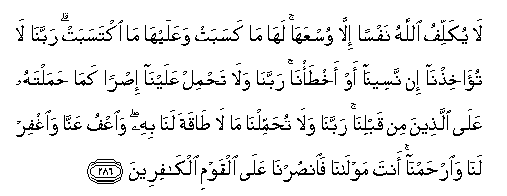
Translation: On no soul doth Allah Place a burden greater than it can bear. It gets every good that it earns, and it suffers every ill that it earns. (Pray:) “Our Lord! Condemn us not if we forget or fall into error; our Lord! Lay not on us a burden Like that which Thou didst lay on those before us; Our Lord! Lay not on us a burden greater than we have strength to bear. Blot out our sins, and grant us forgiveness. Have mercy on us. Thou art our Protector; Help us against those who stand against faith.”

These 2 verses are often recited in Prayer and are fairly easy to memorize. Recite them every night and familiarize yourself with the translation. There is great merit in the recitation of these verses and we can all benefit from them. The last verse is also a supplication to Allah and Insha Allah, by reciting these verses regularly, our prayer will also be accepted.

May Allah pardon our sins and grant us the strength to bear our burdens. Ameen.

Spreading Salaam: The Islamic Greeting

In the name of Allah, most Gracious, most Merciful.

On the authority of Abu Hurayrah (May Allah be pleased with him) it is related that the Prophet (Peace be upon him) said,

“I swear by the one in whose hand lies my soul that you will not enter paradise until you believe. And you shall not believe until you love one another. Shall I tell you something, that if you practice it you will love another? Spread the (Salaam) Islamic greeting amongst yourselves.”

I heard an interesting lecture by Sheikh Anwar Al-Awlaki which reminded me of the importance of spreading Salaam. The Islamic greeting was one of the first orders given to Prophet Adam (A.S) and is a small act of faith many of us may neglect. Many of us study and work with both, Muslims and non-Muslims and I believe it is important to display our faith and its teachings no matter who we associate with.

When in the presence of Muslims, its important to establish the Salaam (Islamic Greeting) as a priority, thereafter you can use any greeting you see fit to address the rest of the group. There’s nothing wrong in saying G’day or Hi, but when addressing fellow Muslims, it is a duty upon us to greet them respectfully and appropriately. The Prophet Muhammad (S.A.W) always established the Salaam first and thereafter would say “An’im sabaahan” or “An’imu sabaahan”  which is the Arabic equivalent of Good Morning.

So don’t be ashamed of spreading Salaam, greet those whom you know and those who you may not know and educate the people around you so they may also learn from the teachings of Islam.

It is narrated on the authority of ‘Abdullah b. ‘Amr that a man asked the Messenger of Allah (may peace and blessings be upon him) which of the merits (is superior) in Islam. He (the Holy Prophet) remarked: That you provide food and extend greetings to one whom you know or do not know.

As-Salāmu `Alaykum – السلام عليكم
Peace be upon you…