A reminder about charity…

In the name of Allah, most Gracious, most Merciful.

Last weekend was the Salvation Army’s Door Knock Appeal and when I heard about it, I thought about whether or not I would donate to the cause and it reminded me of a story I read as a kid about the Prophet Ibrahim (A.S) or Abraham (PBUH) which is available on my post titled Unconditional Charity.

The story demonstrates the importance of unconditional charity and the value of Da’wah through action. Most people would donate to their own religious groups, the true test arises when you are approached by members of other faiths. I still maintain a preference for Islamic Charitable Organisations and I don’t think there can be anything wrong in that, however, the story of Ibrahim (A.S) encourages us as Muslims to be charitable to all of God’s creation.

Be generous and show compassion to both, Muslims and non-Muslims and don’t discriminate in your charity. As Muslims we should understand that no matter what colour we are or what religion we follow, we are all God’s creation. If God himself does not deprive any of His creation from sustenance, how then can we, as His creation, judge between ourselves.

…and remember… “The deeds most loved by Allah are those done regularly, even if they are small.”

Unconditional Charity…

In the name of Allah, most Gracious, most Merciful.

Last weekend was the Salvation Army’s Door Knock Appeal and when I heard about it, I thought about whether or not I would donate to the cause and it reminded me of a story I read as a kid about the Prophet Ibrahim (A.S) or Abraham (PBUH).

Ibrahim (A.S) would never touch food unless there was a beggar in his house, when no beggars visited in a few days, he began to wonder if it was through some fault of his own that God had not sent a beggar to him. Eventually, a beggar came knocking at his door and when he inquired, he learnt that the beggar was a Magian or Fire worshipper. Ibrahim (A.S) proclaimed, ” I cannot help unbelievers who attribute partners to Allah and wander about in this condition. Go away till you have repented, asked forgiveness of God, embraced Islam and cleaned yourself up. Then you will come back to an open door.” As the begged left, Ibrahim heard these words from above: ” Ibrahim, since I, with my Godhead, do not deny him sustenance, despite the fact that he disobeyed me and committed the one sin I do not pardon, namely that of attributing partners to Me, how could you – My servant – send him away without even a crust of bread? Go and make it up to him at once. If you had done this for your own sake, rather than to please Me, I would have wiped you from My friendship.

Upon receiving this divine command, Ibrahim (A.S) took to the road until he found the beggar. He treated him kindly, invited him into his home and fed him well. Through this generosity and charity, the beggar turned to Allah and was blessed with the honour of true faith.

The story demonstrates the importance of unconditional charity and the value of Da’wah through action. Most people would donate to their own religious groups, the true test arises when you are approached by members of other faiths. I still maintain a preference for Islamic Charitable Organisations and I don’t think there can be anything wrong in that, however, the story of Ibrahim (A.S) encourages us as Muslims to be charitable to all of God’s creation.

The Prophet Muhammad (peace be upon him) said: “The believer’s shade on the Day of Resurrection will be his charity.” – Al-Tirmidhi, Hadith 604.

Etiquette of the day of Jumuah: A short reminder…

In the Name of Allah, most Gracious, most Merciful.

Ali Ibn Abu Taalib (RA) narrated:  When Friday comes, the devils go to the markets with their flags, and involve people in their needs and prevent them from the Friday prayer. The angels come early in the morning, sit at the door of the mosque, and record that so-and-so came at the first hour, and so-and-so came at the second hour until the imam comes out (for preaching). When a man sits in a place where he can listen (to the sermon) and look (at the imam), where he remains silent and does not interrupt, he will receive a double reward. If he stays away, sits in a place where he cannot listen (to the sermon), silent, and does not interrupt, he will receive the reward only once. If he sits in a place where he can listen (to the sermon) and look (at the imam), and he does not remain silent, he will have the burden of it. If anyone says to his companion sitting besides him to be silent (while the imam is preaching), he is guilty of idle talk. Anyone who interrupts (during the sermon) will receive nothing (no reward) on that Friday.

Blessed Jumuah…

Etiquette of the day of Jummah: A few reminders…

In the Name of Allah, most Gracious, most Merciful.

“O believers, when the call is proclaimed for the prayer on Friday, come to the remembrance of Allah and leave off business, that is better for you if you but did know.” [Al-Jumuah, 62:9]

Etiquette of the day of Jumuah:

  • Purifying and cleaning oneself
  • Dressing well for Salat-al-Jumuah
  • Reciting Surah al-Kahf
  • Going early to the Masjid
  • Going to the Masjid in a state of calmness and not being hurried.
  • Walking to the Masjid whenever feasible as there is a reward for every step taken to the Masjid.
  • Avoiding stepping over people to get to a particular spot in the Masjid.
  • Avoiding dividing two people who are sitting together.
  • Performing tahiyyat al-Masjid (The prayer of greeting the Musjid)
  • Sitting in the front rows and close to the Imam whenever possible.
  • Reciting Durood upon Prophet Muhammad (S.A.W)
  • Remaining quiet while the Imam is delivering the Khutbah. This actually includes listening to the Imam and not playing with anything while the Imam is speaking.
…and remember… “The deeds most loved by Allah are those done regularly, even if they are small.”
Jumuah Mubarak!

Bite size Dhikr…

In the name of Allah, most Gracious, most Merciful.

I remember having to memorise theses dua’s throughout my childhood to avoid embarrassment in case the Imam quizzed me on it. I must admit, at the time I simply memorised them to comply with the teachings of the Madrassah but didn’t understand the wisdom behind them so it became a mere ritual, something that remained at the back of my mind and surfaced only when and if I was quizzed on it.

That changed when my parents explained the reason’s behind such supplications and I understood that it was more than just something you say or something you read. It’s about showing gratitude and appreciation for the things we have, it’s about humility, respect and the constant remembrance of Allah. My dad always reminded me to recite the dua before eating and it became a habit. I still remember the dua and Insha Allah, I will do the same with my children.

Dua before eating:

بسم الله وبركة الله

Bismillahi wa baraka-tillah.
Translation: With Allah’s name and upon the blessings granted by Allah (do we eat).

Dua after eating:

الْحَمْدُ لِلَّهِ الَّذِى أَطْعَمَنَا وَسَقَانَا وَجَعَلَنَا مُسْلِمِينَ

Alham do lillah hilla-thee At Amana wa saqana waja ‘alana minal Muslimeen.
Translation: All praise is due to Allah who gave us food and drink and who made us Muslims.

Remember the wisdom behind such supplications, they’re not meant to be or become rituals. There is great reward in thanking and remembering Allah so don’t waste the opportunity. These dua’s are short and simple, remember them, practise them and teach them to your family and friends.

Remember Allah at snack time too, not just when you gather for a big meal… enjoy some bite size Dhikr.

…and remember… “The deeds most loved by Allah are those done regularly, even if they are small.” 

Choosing your place in a gathering…

In the name of Allah, most Gracious, most Merciful.

I read a Hadith narrated by Abu Waqid Al-Laith (RA) which tells of three men at a gathering. One of the men found a place within the circle of the gathering, the other sat behind the gathering and the third man walked away. When Prophet Muhammad (S.A.W) completed his talk he said, “shall I tell you about these three persons? One of them betook himself to Allah, so Allah took him into His Grace and Mercy and accommodated him, the second felt shy from Allah, so Allah sheltered him in His mercy (and did not punish him), while the third turned his face from Allah and went away, so Allah turned His face from him likewise.”

I will remember this the next time I am present in a gathering and I hope we can all benefit from this Hadith. Let us be among those whom Allah takes into His Grace and Mercy.

I think it’s important that when we learn or become aware of such teachings that we avoid judging the actions of others. It is through Allah’s mercy that we attain such knowledge and through these actions we may earn His pleasure. Don’t spoil the reward of such an action by judging others or by making them uncomfortable. People may leave Islamic gatherings or might prefer to sit outside them for good reason, it’s not for us to judge or question their intentions, if you are sincere in spreading the knowledge then narrate to them the above Hadith and Insha Allah through you, they too will earn Allah’s pleasure.

A good place to start will be in the Musjid at Jumuah, Insha Allah I will find a place nearest to the front. It’s a shame that the back wall gets full so early in the sermon.

"Quran time"

In the Name of Allah, most Gracious, most Merciful.

Just a little reminder and some motivation to read Quran every day. I’ve found that regular recitation of the Quran, no matter how much or how little, will allow you to cope better with day to day trials and challenges. There is something enlightening about reciting Quran and whether you understand it or not, we can all benefit from it.

Allah says “If anyone finds no time for my remembrance and for begging My favours due to remaining engaged in the recitation of the Quran , I shall give him more than what I give to all those who beg favours of Me.” The superiority of the Word of Allah over all other words is like the superiority of Allah over the entire creation.

One who recites the Quran and he is well versed in it ( i.e its recitation), he will be in the company of those angles who are scribes, noble and righteous; and one who falters in the recitation and has to exert himself, gets a double reward.

If Almighty Allah opens the locks of your heart, then you would become aware of the marvels, wisdom and knowledge found in the Holy Qur’an, with the result that you would not have to ponder on other sources. Because whatever there is, found in its pages, as the Almighty says in the Holy Qur’an:” Nothing have we omitted from the Book” (Surah Anam Verse 38).

Schedule some ‘Quran time’ in your day so you can benefit from one of the greatest favours from our Lord. A few minutes in the morning or before you get to bed, make it habit and encourage those around you. Whether you understand Arabic or not, recite sincerely and you will feel the effects of divine guidance in every aspect of life.

…and remember… “The deeds most loved by Allah are those done regularly, even if they are small.”


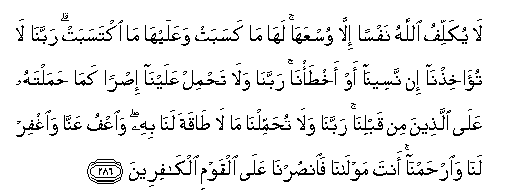
The last 2 verses of Surah Al-Baqarah

In the name of Allah, most Gracious, most Merciful.

The Prophet (Sallallahu ‘Alaihi Wa Sallam) said, “If one recites the last two Verses of Surat-al-Baqara at night, it is sufficient for him (for that night).”


It is reported on the authority of ‘Ali (RA) that he said:

“I do not consider it fitting for anyone who has understood Islam to sleep (at night) until he has recited Ayat Al- Kursi-and the ending of Surat Al-Baqarah, for they are a gift to your Prophet (SAW) from the treasure which lies beneath the Throne.” (Narrated by Ibn Mardawaih)

Translation: The Messenger believeth in what hath been revealed to him from his Lord, as do the men of faith. Each one (of them) believeth in Allah, His angels, His books, and His messengers. “We make no distinction (they say) between one and another of His messengers.” And they say: “We hear, and we obey: (We seek) Thy forgiveness, our Lord, and to Thee is the end of all journeys.”

Translation: On no soul doth Allah Place a burden greater than it can bear. It gets every good that it earns, and it suffers every ill that it earns. (Pray:) “Our Lord! Condemn us not if we forget or fall into error; our Lord! Lay not on us a burden Like that which Thou didst lay on those before us; Our Lord! Lay not on us a burden greater than we have strength to bear. Blot out our sins, and grant us forgiveness. Have mercy on us. Thou art our Protector; Help us against those who stand against faith.”

These 2 verses are often recited in Prayer and are fairly easy to memorize. Recite them every night and familiarize yourself with the translation. There is great merit in the recitation of these verses and we can all benefit from them. The last verse is also a supplication to Allah and Insha Allah, by reciting these verses regularly, our prayer will also be accepted.

May Allah pardon our sins and grant us the strength to bear our burdens. Ameen.

Spreading Salaam: The Islamic Greeting

In the name of Allah, most Gracious, most Merciful.

On the authority of Abu Hurayrah (May Allah be pleased with him) it is related that the Prophet (Peace be upon him) said,

“I swear by the one in whose hand lies my soul that you will not enter paradise until you believe. And you shall not believe until you love one another. Shall I tell you something, that if you practice it you will love another? Spread the (Salaam) Islamic greeting amongst yourselves.”

I heard an interesting lecture by Sheikh Anwar Al-Awlaki which reminded me of the importance of spreading Salaam. The Islamic greeting was one of the first orders given to Prophet Adam (A.S) and is a small act of faith many of us may neglect. Many of us study and work with both, Muslims and non-Muslims and I believe it is important to display our faith and its teachings no matter who we associate with.

When in the presence of Muslims, its important to establish the Salaam (Islamic Greeting) as a priority, thereafter you can use any greeting you see fit to address the rest of the group. There’s nothing wrong in saying G’day or Hi, but when addressing fellow Muslims, it is a duty upon us to greet them respectfully and appropriately. The Prophet Muhammad (S.A.W) always established the Salaam first and thereafter would say “An’im sabaahan” or “An’imu sabaahan”  which is the Arabic equivalent of Good Morning.

So don’t be ashamed of spreading Salaam, greet those whom you know and those who you may not know and educate the people around you so they may also learn from the teachings of Islam.

It is narrated on the authority of ‘Abdullah b. ‘Amr that a man asked the Messenger of Allah (may peace and blessings be upon him) which of the merits (is superior) in Islam. He (the Holy Prophet) remarked: That you provide food and extend greetings to one whom you know or do not know.

As-Salāmu `Alaykum – السلام عليكم
Peace be upon you…

Etiquette at Jummah (Friday Prayer): Finding your place in the crowd

In the name of Allah, most Gracious, most Merciful.

We’ve all experienced this at the mosque at some point. You get to the mosque late and you can’t find a spot to pray so you find a gap between two brothers and force your way in; or you get there early to get a good seat and some late-comer squeezes between you and the brother beside you and suddenly you’re curled up to one side thinking… why me?

The next time you face this dilemma, think about the following Hadith:

The Prophet (p.b.u.h) said, “Whoever takes a bath on Friday, purifies himself as much as he can, then uses his (hair) oil or perfumes himself with the scent of his house, then proceeds (for the Jummah prayer) and does not separate two persons sitting together (in the mosque), then prays as much as (Allah has) written for him and then remains silent while the Imam is delivering the Khutbah, his sins in-between the present and the last Friday would be forgiven.”

The Hadith emphasizes the importance of etiquette at the Mosque. Be courteous towards your fellow worshippers, this will benefit you and those around you and will facilitate a healthy, peaceful praying environment. Most Mosques and Prayer halls struggle to cope with the crowd at Jummah Prayers so you are bound to have a space issue and will sometimes be forced to inconvenience fellow worshippers, be polite about it and there will be reward in that too Insha Allah. If you do a righteous act, do it for Allah and likewise, if you restrain yourself from committing a sin, do it for Allah.

Jummah Mubarak!

…and remember… “The deeds most loved by Allah are those done regularly, even if they are small.”