Blessed Eid…

In the name of Allah, most Gracious, most Merciful.

As we reach the end of Ramadhan, I pray that our efforts and sacrifice is accepted. The month of Ramadhan inspires many each year, I sincerely hope we can all learn from our experiences over the last month and implement a change to our lifestyles throughout the year. Ramadhan may only last 30 days, but there’s no reason for our spirituality to end with the new crescent. Reflect on some of your achievements over the last few weeks, no doubt we may have made a few mistakes but Insha Allah our shortcomings will be overlooked. Don’t forget Ramadhan, don’t forget the mercy and blessings we all experienced and most of all, do not forget Allah. Let us all try to maintain the level of faith we attained in Ramadhan and may we all witness many more Blessed months Insha Allah.

Eid Mubarak!

Jumuah @ School…

In the name of Allah, most Gracious, most Merciful. 

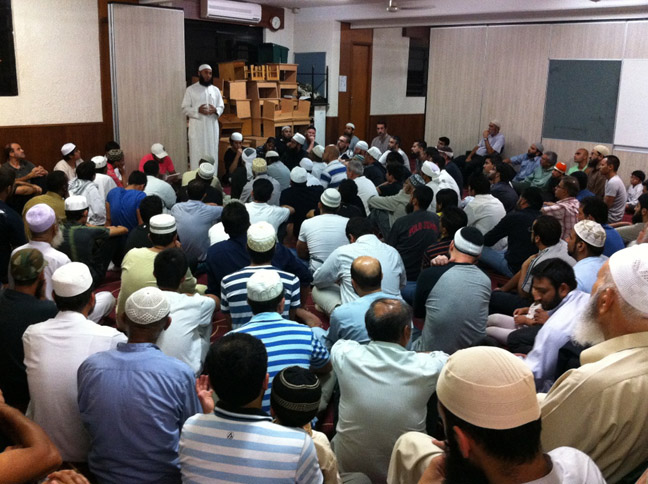
Alhamdulillah, with the Grace of Allah, we were able to conduct Jumuah Salaah at Benowa State High School this afternoon. We hope that this will continue and that the attendance will improve each week. The principal, teachers and students were very accommodating which made for a very relaxed and casual environment. We even had a few non-Muslim spectators which is always a good sight. The school is very Multicultural and brought back memories of my days in High School.

Despite the negative publicity Muslims get in the media, we have much to be grateful for. I remember Jumuah at school and I believe that fostering an Islamic environment in schools can greatly influence the youth. I sincerely hope we are able to maintain this arrangement and that the students can benefit from this initiative. I don’t believe that prayer facilities in non-Muslims schools is a right of Muslims, it is a privilege and is something we should acknowledge and show our appreciation for. 

May Allah guide the youth and allow them to become righteous leaders of Islam. 

…My heart aches for Africa

In the name of Allah, most Gracious, most Merciful.

My heart aches with every headline, every story and every photo that’s flashed across the screen. This crisis has been covered by the media and has been shared by every concerned individual and group through every possible social platform. Over the last few weeks, the crisis in Africa has flooded my inbox and social media streams. Africa is no stranger to crisis and at first, I must admit, I didn’t pay much attention. We live in a world where we can spend lavishly on ourselves while our neighbours go without food, how then can we relate to a crisis on the other side of the world?

Today, my heart aches for Africa. As my 7 month old son cried for food today, an imaged flashed before me that jolted my senses and sent a rush of emotion through me. I pictured a starving child in Africa. I remembered the images that had been circulating on Facebook and Twitter and I could almost hear their cries of hunger. As I came to terms with the heartbreaking images and thoughts going through my mind, I was grateful to Allah for blessing us and providing for us. Remembering Allah relieved some of the emotion I was experiencing but the reality remained… As we go about our daily lives, children are starving, Africa is suffering yet again.

Our self-centred, materialistic lifestyles have conditioned our minds to overlook such atrocities; we live in a world of suffering and to some extent have become oblivious to human suffering around the world. A sad yet undeniably truth. I find it very difficult to maintain this “out of sight, out of mind” attitude towards such suffering. I was born and raised in Africa; I saw poverty and suffering every morning and every evening. I remember feeling saddened at the sight of little boys walking barefoot on the hot African sand begging for food and money. My parents (may Allah reward them) would feed and clothe these kids to keep them off the streets. As a child there was little I could do, but I felt for them then, and I feel for them now. There are some things in life that will never leave you, we left Africa 10 years ago and I can still remember their faces, I can still remember the poverty, I can still remember the suffering. The crisis in The Horn of Africa has reminded me of my experience and memories of a people whose history has been plagued by disease, hunger and suffering. Today, my heart aches for Africa.

I read an article which told the story of a mother who was travelling on foot with her two children in an attempt to escape the famine in Somalia. A few days in to their journey, her son collapsed from dehydration, after using the last few drops of water to wake him, the mother was faced with the choice of leaving her son to die and journey on, or stay and starve to death with him and his little sister. No mother should have to make that choice, no son should have to experience that and no daughter should have to witness that. As I read the story, I was reminded of an episode of Great Migrations I recently watched. A herd of Wildebeest were migrating during the dry season, a mother wildebeest became separated from the herd as she cared for her weak calf. As the herd moved further and further away, the mother was forced to abandon her calf to re-join the herd in search of water.  It was difficult enough to watch the wildebeest story, I cannot begin to describe the heartache I felt when I read the story about the woman in Somalia.

I don’t have a solution to the crisis but I believe we can all contribute in our own way. Some may volunteer their time and effort while others may contribute financially, however, the least we can do as human beings is care. So long as there is concern for those who are suffering in our hearts, there is hope for them.

As we go on living our lives of comfort, as we eat our food, drink our water and rest in our beds, spare a thought for the people of Africa and be grateful to God for the blessings He has bestowed upon us.

Today, my heart aches for Africa…


Ibrahim Ad’ham and the 10 things that prevent our prayers from being answered…

In the name of Allah, most Gracious, most Merciful.

Allah says in the Holy Quran: Call upon Me, and I will answer your prayers. Why then are some of our prayers not answered?

Ibrahim Ad’ham who was once the ruler of Khurasan was asked this question and responded with: “Because of ten things your hearts are dead; if a person has these ten bad qualities in him, how should God accept his prayer?’

The ten qualities are:

  1. You acknowledge Allah, you pretend to acknowledge Him, and yet you do not give His due
  2. You read the Quran, yet you do not observe it’s commands and prohibitions
  3. Although you say that Satan is your enemy, you follow and obey him
  4. You call yourselves members of the Ummah of Muhammad (S.A.W), yet you do not follow his examples
  5. You claim that you will go to paradise, yet you do none of the deeds required to gain entrance therein
  6. You wish to achieve salvation from the Fire of Hell, yet you throw yourselves into it by committing sin
  7. You know that death is inevitable, yet you make no preparation for it
  8. You pay a lot of attention to the faults of others, yet you do not see your own faults
  9. You consume the bounty of your Lord without showing gratitude
  10. You bury your dead without taking warning
Check yourself before you wreck yourself!
O Allah, graciously afford us the gift of faith and spirituality, and include us among those who achieve success and find salvation from the Hell fire… Ameen!

Unconditional Charity…

In the name of Allah, most Gracious, most Merciful.

Last weekend was the Salvation Army’s Door Knock Appeal and when I heard about it, I thought about whether or not I would donate to the cause and it reminded me of a story I read as a kid about the Prophet Ibrahim (A.S) or Abraham (PBUH).

Ibrahim (A.S) would never touch food unless there was a beggar in his house, when no beggars visited in a few days, he began to wonder if it was through some fault of his own that God had not sent a beggar to him. Eventually, a beggar came knocking at his door and when he inquired, he learnt that the beggar was a Magian or Fire worshipper. Ibrahim (A.S) proclaimed, ” I cannot help unbelievers who attribute partners to Allah and wander about in this condition. Go away till you have repented, asked forgiveness of God, embraced Islam and cleaned yourself up. Then you will come back to an open door.” As the begged left, Ibrahim heard these words from above: ” Ibrahim, since I, with my Godhead, do not deny him sustenance, despite the fact that he disobeyed me and committed the one sin I do not pardon, namely that of attributing partners to Me, how could you – My servant – send him away without even a crust of bread? Go and make it up to him at once. If you had done this for your own sake, rather than to please Me, I would have wiped you from My friendship.

Upon receiving this divine command, Ibrahim (A.S) took to the road until he found the beggar. He treated him kindly, invited him into his home and fed him well. Through this generosity and charity, the beggar turned to Allah and was blessed with the honour of true faith.

The story demonstrates the importance of unconditional charity and the value of Da’wah through action. Most people would donate to their own religious groups, the true test arises when you are approached by members of other faiths. I still maintain a preference for Islamic Charitable Organisations and I don’t think there can be anything wrong in that, however, the story of Ibrahim (A.S) encourages us as Muslims to be charitable to all of God’s creation.

The Prophet Muhammad (peace be upon him) said: “The believer’s shade on the Day of Resurrection will be his charity.” – Al-Tirmidhi, Hadith 604.

Lending a helping hand in QLD, Australia

In the name of Allah, most Gracious, most Merciful.

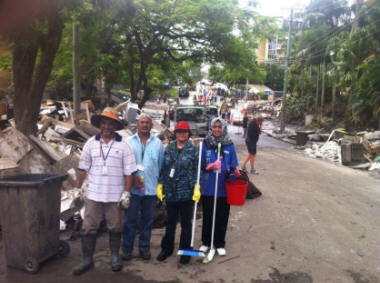
I’d like to congratulate and acknowledge the efforts of the Muslim Volunteers who assisted with the QLD Flood Crisis. I pray that you are rewarded in this world and in the hereafter Insha Allah.

Below is a letter received from a victim of the recent floods.

_____________________________________

Thank you so much, we went without food etc. for 3 days and eventually got picked up and were at Lowood Evacuation Centre when you delivered your bundles of kindness….we were home again and after a few days SES came to help hose mud out of sheds….they also brought out one of your green bags which was very much appreciated.

I was so impressed that it was a brand new face washer not to mention the brand new toothbrushes and the amount of thought put into the contents.

If we can return your kindness in any way please let us know. My 6yr old son goes to West Moreton Anglican College…maybe your priest could talk to the chaplain and give a talk on Muslim spirituality and join in chapel one morning.

I am technically Church of England but I don’t know much about religion. With all the hostility in the world it is a wonderful thing that your faith has done for the flood victims.

I know my family will never forget your kindness and the effort you went to for us.

Thank you with all my heart

Name Withheld

_____________________________________

This is a true form of Dawah and an excellent display of Islam in Queensland. I hope we hear of many stories like this one, Queensland is not short of natural disasters this year, so lets take advantage of this and spread Islam by being good Muslims.


Lending a helping hand!

In the name of Allah, most Gracious, most Merciful.

____________________________________

To help a Muslim in some important work and to do it for his sake or to remove his troubles and worries is an act which has been promised much reward by the Prophet. Abdullah bin Omar said that our Holy Prophet said, “’One who helps someone in his need, Allah helps him in his work, and one who removes any worry or trouble of any Muslim, Allah, in return, removes anyone of his worries on the Day of Judgment’. (Abu Daud, Kilab-al-Adab, Bad-al-Muvakhat)

Showing someone the way, sharing someone’s load or helping him with it, and all other acts of public service are included in the acts defined by this Hadith.  “Those who help others are truly much blessed,” as the Hadith says, “Best people are those who are useful to others.”

Hence all occasions of service, big or small, must be sought for; this increases one’s merits. If someone is a victim of tyranny, it is the duty of every Muslim to save him from it.

A Hadith tells us that the  Prophet Muhammad (S.A.W) said “A Muslim is the brother of another Muslim”, and “A brother does not leave his brother helpless nor does he lie to him nor yet makes false promises, nor treats him with cruelty.” (Tirmidhi: AI Birr wa-al- Silah)

Another Hadith states that, “If a Muslim is being insulted and degraded and his honour besmirched somewhere and another Muslim leaves him helpless, Allah would leave the latter helpless on occasions when he would need help. And if any Muslim helps him in when he is insulted and degraded, Allah shall help him when he would need help” (Abu Da’ud: Adab)

Helping a Muslim includes appropriate refutal of any wrong charges or insinuations levelled against another Muslim. Abu Darda’ report that our Holy Prophet has said, “One who defends the honour of his brother, Allah keeps the fire of hell away from his face on the Day of Judgment.” (Tirmidhi: al Birr wa al Silah, Chapter 20) *

____________________________________

* Above post written and researched by a friend and fellow brother in Islam – May Allah reward him.

In the wake of the current crisis in Egypt and the ongoing struggle for Palestine, it is important to understand that as Muslims and as Human Beings, we have certain rights and obligations towards each other.  Remember this when you next see someone in need and if you can assist, do so with sincerity and for no reason but for the abovementioned Hadith. It is important to remind ourselves of such sayings and Hadith so if we are given the opportunity to assist or lend a helping hand, we do so for the right reasons, with the right intentions and Insha Allah we’ll be rewarded.

Following the recent flood crisis in Queensland, an Imam urged his congregation to extend the Muslim brotherhood to the people of Queensland. He emphasised the need and the duty for  Muslims to assist the broader community especially at times of crisis. I believe this is one of the greatest forms of Dawah and is an effective way of displaying our Faith.

I would like to emphasise the principle in the above Hadith and extend it to both, Muslims and non-Muslims. We engage with members of various faiths and beliefs on a daily basis and our religion is on display and under scrutiny 24/7. Islam teaches peace, love, respect and understanding and does not limit it to Muslims only. Sometimes lending a helping hand could make the difference between a Muslim and non-Muslim.

I hope we can implement this in our daily routine, spare a thought for your neighbour, your colleague, the guy on the street or the old lady at the shopping centre. Even the smallest of actions could have ever-lasting effects.

May Allah assist us and allow us the opportunity to assist others.


An Islamic adaptation of the Sabbath…

In the name of Allah, most gracious, most merciful.

I recently became aware of the religious beliefs and rituals of some of the people I work with and I found the idea of the Sabbath very intriguing. Most people know the Sabbath to be the day Jews are forbidden to work,  however from  a Jewish perspective it is more than just rules and restriction.  As Tracey R. Rich puts it, “”it is a precious gift from God, a day of great joy eagerly awaited throughout the week, a time when we can set aside all of our weekday concerns and devote ourselves to higher pursuits.” According to the Torah,  the purpose of Sabbath observance is to remind the Hebrew people of two very important events in history: the creation of the world (Ex. 20:11) and the deliverance from slavery in Egypt (Deut. 5:15). Both highlight the central Jewish religious belief: that there is one, powerful creator God who cares for his people.

People of different religions and faiths observe the Sabbath in different ways and for different reasons. For members of the Church of Jesus Christ of Latter-day Saints or Mormons, Sunday is a quiet day for church attendance, rest from worldly pursuits, and spiritual reflection. I work very closely with members of the Mormon Church and their beliefs and spirituality have truly inspired me.

While different religions have different interpretations of the Sabbath, the principle remains the same and I believe the principle is Islamic at its core.

Examples of appropriate Sabbath activities include:

  • Attending Church
  • Prayer
  • Reflection & Contemplation
  • Studying scriptures
  • Spending time with family
  • Visiting the sick
  • Physical rest

As a Muslim, I was amazed at the spiritual devotion of the people who observe the Sabbath and I questioned my own devotion and spirituality. I began contemplating an Islamic adaptation the Sabbath.

Based on the principles and teachings of Islam and drawing inspiration from the Jewish and Mormon faiths, I believe we can increase our spirituality and our awareness of God by setting aside Sabbath-like periods in our lives.

Depending on the level of your faith and your circumstances this could be implemented daily, weekly or however you see fit. The frequency and duration is up to the individual, but the intention should be for the pleasure of Allah and to elevate your spirituality.

Examples of appropriate activities from an Islamic perspective would include:

  • Reading Quran
  • Prayer/Dua
  • Reading/Learning Hadith
  • Optional (Nafl)  Prayers
  • Spending time with the family (NO TV)
  • Visiting the sick
  • Fasting
  • Dhikr & the remembrance of Allah
  • Visiting the Mosque (besides the daily prayers)

The key is to avoid all worldly matters and take part in activities that will enhance your spirituality and create a better awareness and understanding of your faith.

Some may argue that we should be practising these activities all the time anyway, even if we do, there can be no harm in setting aside time each day or each week in devotion to your Lord.

I hope we can all benefit from this, set aside some time each day or each week to remove yourself from worldly matters and spend some time contemplating and reflecting on your faith. Insha Allah we will become better Muslims and will better appreciate the bounties of our Lord.

” O ye who believes remember Allah very often and glorify Him morning and evening.” (33:41-2)

” Then do ye remember Me I will remember you.” (2-152)

Inspiration: Live Life!

In the name of Allah, most Gracious, most Merciful.

Sometimes people come into your life and you know right away that they were meant to be there, to serve some sort of purpose, teach you a lesson, or to help you figure out who you are or who you want to become. You never know who these people may be – a roommate, a neighbour, a professor, a friend, a lover, or even a complete stranger – but when you lock eyes with them, you know at that very moment they will affect your life in some profound way.

Sometimes things happen to you that may seem horrible, painful, and unfair at first, but in reflection you find that without overcoming those obstacles you would have never realized your potential, strength, willpower, or heart.

Illness, injury, love, lost moments of true greatness, and sheer stupidity all occur to test the limits of your soul. Without these small tests, whatever they may be, life would be like a smoothly paved straight flat road to nowhere. It would be safe and comfortable, but dull and utterly pointless.

The people you meet who affect your life, and the success and downfalls you experience, help to create who you are and who you become. Even the bad experiences can be learned from. In fact, they are sometimes the most important ones.

If someone loves you, give love back to them in whatever way you can, not only because they love you, but because in a way, they are teaching you to love and how to open your heart and eyes to things.

If someone hurts you, betrays you, or breaks your heart, forgive them, for they have helped you learn about trust and the importance of being cautious to whom you open your heart.

Make every day count. Appreciate every moment and take from those moments everything that you possibly can for you may never be able to experience it again. Talk to people that you have never talked to before, and listen to what they have to say.

Let yourself fall in love, break free, and set your sights high. Hold your head up because you have every right to. Tell yourself you are a great individual and believe in yourself, for if you don’t believe in yourself, it will be hard for others to believe in you.

You can make anything you wish of your life. Create your own life and then go out and live it with absolutely no regrets.

And if you love someone tell them, for you never know what tomorrow may have in store.

Learn a lesson in life each day that you live!

Remember, today is the tomorrow you were worried about yesterday.

Think About it? Was it worth it?

_______________________________________________________________________________

Uncredited article – courtesy of Gold Coast Islam Newsletter
 

Dead Sea Seacret… Religious Perspective!

The Dead Sea

I was quite impressed after sampling a treatment from a “Seacret” store in the mall the other day and found that the source of these treatments was the Dead Sea. I could recall a few childhood stories about the Dead Sea which made me question the permissibility and appropriateness of using such treatments. This is what I found:

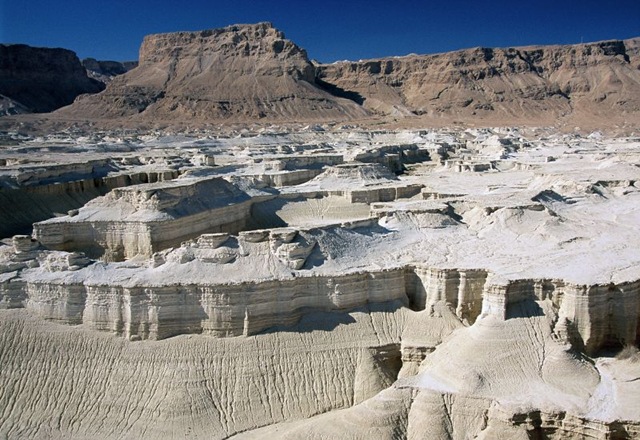
According to Islamic and Biblical traditions, the Dead Sea is the site of the ancient city of Sodom, home of the Prophet Lut (Lot), peace be upon him.

Prophet Lut (A.S.), after consulting with Prophet Ibrahim (Abraham) (A.S.) left Misr and traversed towards the eastern part of Urdun (Jordan), a place called Sodom or Sadoom. The purpose of his migration was to propagate the teachings of Ibrahim (A.S.) amongst the inhabitants of Sodom, a village situated in the area where the Dead Sea is presently located.

The people of surrounding areas firmly believe that the region in which the Dead Sea is found was once occupied by the people of Sodom. This nation directly rejected the message which Prophet Lut (A.S.) presented to them, due to which they were punished most severely, as described by Allah, “So at day break a mighty cry seized them. Then We turned the localities upside down and We showered upon them rocks of baked clay. In this (incident) there are indeed multiple signs for the people who discern.” (Surah Hijr, Verse 73)

The earth on which they lived was lifted into the sky and then caused to come crashing down approximately 400 meters below the earth. As a result, this area was submerged, and is now known as the Dead Sea. (Qasas ul Qur’an, Vol. 1, Page 257, Mukhtasar Tafseer Ibn Katheer, Vol. 2, Page 312) According to scientists, the area is covered in large deposits of sulphur. For this reason, no life in the form of animals or plants is to be found there and the region stands as a symbol of destruction.

It has been reported by Abdullah ibn Umar (R.A.), that when Prophet Muhammad (S.A.W.) descended at the place of Hijr (the region where the nations of ‘Aad and Thamud once resided) during the battle of Tabuk, he (S.A.W.) commanded the Sahabah (companions) not to drink from the accursed place. The Sahabah informed the Prophet (S.A.W.) that they had already utilized the water for making dough and drinking. The Prophet (S.A.W.) instructed them to discard the dough and water.

While commenting on this Hadith, Imam Hajar Al-Asqalani (R.H.) outlines that the Hadith clearly teaches us that, it is Makrooh (impermissible) to use the water found in the area of Hijr. He further states, that the same ruling will apply to other accursed places.

The Prophet Muhammad (S.A.W), reportedly tried to dissuade people from visiting the sites of God’s punishment: “Do not enter the place of those who were unjust to themselves, unless you are weeping, lest you should suffer the same punishment as was inflicted upon them.”

The Qur’an describes that the site of this punishment has been left as a sign for those who follow: “Surely! In this are signs for those who understand. And verily, they (the cities) are right on the high-road. Surely! Therein is indeed a sign for the believers.” (Qur’an 15:75-77)

In light of the above narrations, revelations and explanations, we can conclude that the use of products derived from the Dead Sea is inappropriate and should be avoided. I hope we can all benefit from this Insha Allah. May Allah strengthen our faith and make us among those who guide and whom are guided.

Ameen.

Assalaamu Alaikum!