Ibrahim Ad’ham and the 10 things that prevent our prayers from being answered…

In the name of Allah, most Gracious, most Merciful.

Allah says in the Holy Quran: Call upon Me, and I will answer your prayers. Why then are some of our prayers not answered?

Ibrahim Ad’ham who was once the ruler of Khurasan was asked this question and responded with: “Because of ten things your hearts are dead; if a person has these ten bad qualities in him, how should God accept his prayer?’

The ten qualities are:

  1. You acknowledge Allah, you pretend to acknowledge Him, and yet you do not give His due
  2. You read the Quran, yet you do not observe it’s commands and prohibitions
  3. Although you say that Satan is your enemy, you follow and obey him
  4. You call yourselves members of the Ummah of Muhammad (S.A.W), yet you do not follow his examples
  5. You claim that you will go to paradise, yet you do none of the deeds required to gain entrance therein
  6. You wish to achieve salvation from the Fire of Hell, yet you throw yourselves into it by committing sin
  7. You know that death is inevitable, yet you make no preparation for it
  8. You pay a lot of attention to the faults of others, yet you do not see your own faults
  9. You consume the bounty of your Lord without showing gratitude
  10. You bury your dead without taking warning
Check yourself before you wreck yourself!
O Allah, graciously afford us the gift of faith and spirituality, and include us among those who achieve success and find salvation from the Hell fire… Ameen!

Etiquette of the day of Jummah: A few reminders…

In the Name of Allah, most Gracious, most Merciful.

“O believers, when the call is proclaimed for the prayer on Friday, come to the remembrance of Allah and leave off business, that is better for you if you but did know.” [Al-Jumuah, 62:9]

Etiquette of the day of Jumuah:

  • Purifying and cleaning oneself
  • Dressing well for Salat-al-Jumuah
  • Reciting Surah al-Kahf
  • Going early to the Masjid
  • Going to the Masjid in a state of calmness and not being hurried.
  • Walking to the Masjid whenever feasible as there is a reward for every step taken to the Masjid.
  • Avoiding stepping over people to get to a particular spot in the Masjid.
  • Avoiding dividing two people who are sitting together.
  • Performing tahiyyat al-Masjid (The prayer of greeting the Musjid)
  • Sitting in the front rows and close to the Imam whenever possible.
  • Reciting Durood upon Prophet Muhammad (S.A.W)
  • Remaining quiet while the Imam is delivering the Khutbah. This actually includes listening to the Imam and not playing with anything while the Imam is speaking.
…and remember… “The deeds most loved by Allah are those done regularly, even if they are small.”
Jumuah Mubarak!

Bite size Dhikr…

In the name of Allah, most Gracious, most Merciful.

I remember having to memorise theses dua’s throughout my childhood to avoid embarrassment in case the Imam quizzed me on it. I must admit, at the time I simply memorised them to comply with the teachings of the Madrassah but didn’t understand the wisdom behind them so it became a mere ritual, something that remained at the back of my mind and surfaced only when and if I was quizzed on it.

That changed when my parents explained the reason’s behind such supplications and I understood that it was more than just something you say or something you read. It’s about showing gratitude and appreciation for the things we have, it’s about humility, respect and the constant remembrance of Allah. My dad always reminded me to recite the dua before eating and it became a habit. I still remember the dua and Insha Allah, I will do the same with my children.

Dua before eating:

بسم الله وبركة الله

Bismillahi wa baraka-tillah.
Translation: With Allah’s name and upon the blessings granted by Allah (do we eat).

Dua after eating:

الْحَمْدُ لِلَّهِ الَّذِى أَطْعَمَنَا وَسَقَانَا وَجَعَلَنَا مُسْلِمِينَ

Alham do lillah hilla-thee At Amana wa saqana waja ‘alana minal Muslimeen.
Translation: All praise is due to Allah who gave us food and drink and who made us Muslims.

Remember the wisdom behind such supplications, they’re not meant to be or become rituals. There is great reward in thanking and remembering Allah so don’t waste the opportunity. These dua’s are short and simple, remember them, practise them and teach them to your family and friends.

Remember Allah at snack time too, not just when you gather for a big meal… enjoy some bite size Dhikr.

…and remember… “The deeds most loved by Allah are those done regularly, even if they are small.” 

The last 2 verses of Surah Al-Baqarah

In the name of Allah, most Gracious, most Merciful.

The Prophet (Sallallahu ‘Alaihi Wa Sallam) said, “If one recites the last two Verses of Surat-al-Baqara at night, it is sufficient for him (for that night).”


It is reported on the authority of ‘Ali (RA) that he said:

“I do not consider it fitting for anyone who has understood Islam to sleep (at night) until he has recited Ayat Al- Kursi-and the ending of Surat Al-Baqarah, for they are a gift to your Prophet (SAW) from the treasure which lies beneath the Throne.” (Narrated by Ibn Mardawaih)

Translation: The Messenger believeth in what hath been revealed to him from his Lord, as do the men of faith. Each one (of them) believeth in Allah, His angels, His books, and His messengers. “We make no distinction (they say) between one and another of His messengers.” And they say: “We hear, and we obey: (We seek) Thy forgiveness, our Lord, and to Thee is the end of all journeys.”

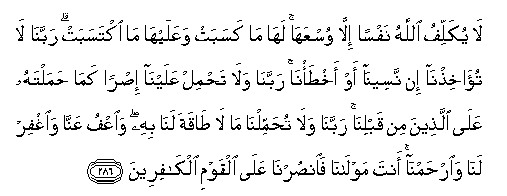
Translation: On no soul doth Allah Place a burden greater than it can bear. It gets every good that it earns, and it suffers every ill that it earns. (Pray:) “Our Lord! Condemn us not if we forget or fall into error; our Lord! Lay not on us a burden Like that which Thou didst lay on those before us; Our Lord! Lay not on us a burden greater than we have strength to bear. Blot out our sins, and grant us forgiveness. Have mercy on us. Thou art our Protector; Help us against those who stand against faith.”

These 2 verses are often recited in Prayer and are fairly easy to memorize. Recite them every night and familiarize yourself with the translation. There is great merit in the recitation of these verses and we can all benefit from them. The last verse is also a supplication to Allah and Insha Allah, by reciting these verses regularly, our prayer will also be accepted.

May Allah pardon our sins and grant us the strength to bear our burdens. Ameen.

Remembering Allah every day…

In the name of Allah, most Gracious, most Merciful.


Never underestimate the power of remembering Allah, even the mere acknowledgement and awareness of Allah in our daily lives could have a positive influence on us and the people around us. Make it a habit to thank Allah everyday and Insha Allah your level of faith will increase daily. There is a reward for the act of remembering Allah (Dhikr), a reward for being grateful to Allah and the satisfaction of knowing that Allah will be there for you in times of need.

فَاذْكُرُونِي أَذْكُرْكُمْ وَاشْكُرُوا لِي وَلَا تَكْفُرُونِ”. البقرة

“Therefore remember Me. I will remember you. Be grateful to Me and never show Me ingratitude” – Al-Baqarah 2:152

A simple dua to make everyday:

“Oh Allah, I thank you for everything you have provided for me today, I seek your protection from all things evil and I beg your forgiveness for the sins I may have committed.”

A small prayer, a small thought, a few seconds everyday.

…and remember… “The deeds most loved by Allah are those done regularly, even if they are small.”

Dua for your wives and children…

In the name of Allah, most Gracious, most Merciful.

A little dua to ensure a righteous partner and obedient children. Recitation of this dua should also serve as a reminder for you to be a righteous partner and obedient to your parents.

رَبَّنَا هَبْ لَنَا مِنْ أَزْوَاجِنَا وَذُرِّيَّاتِنَا قُرَّةَ أَعْيُنٍ وَاجْعَلْنَا لِلْمُتَّقِينَ إِمَامًا

Rabbana hab-lana min azwajina wathurriyyatina qurrata aAAyunin waijAAalna lilmuttaqeena imama

“Our Lord! Grant unto us wives and offspring who will be the comfort of our eyes, and give us (the grace) to lead the righteous.”


…and remember… “The deeds most loved by Allah are those done regularly, even if they are small.”


Dua for your parents…

In the name of Allah, most Gracious, most Merciful.

Remember your parents and thank them at every opportunity. Make dua for them daily and Insha Allah you & your parents will benefit from this.

Rabbighfir lii wali-waalidayya walil-muminiina yauma yaquumul hisaab, Rabbirhamhumaa kamaa rabbayaani saghiiraa.

O Lord, forgive me, my parents and Muslims in the Hereafter. O Lord, show mercy on them as they have nourished me when I was young.

Remember your parents, thank them, make dua for them and Allah will be pleased with you. A true win-win situation.

…and remember… “The deeds most loved by Allah are those done regularly, even if they are small.”

Lending a helping hand!

In the name of Allah, most Gracious, most Merciful.

____________________________________

To help a Muslim in some important work and to do it for his sake or to remove his troubles and worries is an act which has been promised much reward by the Prophet. Abdullah bin Omar said that our Holy Prophet said, “’One who helps someone in his need, Allah helps him in his work, and one who removes any worry or trouble of any Muslim, Allah, in return, removes anyone of his worries on the Day of Judgment’. (Abu Daud, Kilab-al-Adab, Bad-al-Muvakhat)

Showing someone the way, sharing someone’s load or helping him with it, and all other acts of public service are included in the acts defined by this Hadith.  “Those who help others are truly much blessed,” as the Hadith says, “Best people are those who are useful to others.”

Hence all occasions of service, big or small, must be sought for; this increases one’s merits. If someone is a victim of tyranny, it is the duty of every Muslim to save him from it.

A Hadith tells us that the  Prophet Muhammad (S.A.W) said “A Muslim is the brother of another Muslim”, and “A brother does not leave his brother helpless nor does he lie to him nor yet makes false promises, nor treats him with cruelty.” (Tirmidhi: AI Birr wa-al- Silah)

Another Hadith states that, “If a Muslim is being insulted and degraded and his honour besmirched somewhere and another Muslim leaves him helpless, Allah would leave the latter helpless on occasions when he would need help. And if any Muslim helps him in when he is insulted and degraded, Allah shall help him when he would need help” (Abu Da’ud: Adab)

Helping a Muslim includes appropriate refutal of any wrong charges or insinuations levelled against another Muslim. Abu Darda’ report that our Holy Prophet has said, “One who defends the honour of his brother, Allah keeps the fire of hell away from his face on the Day of Judgment.” (Tirmidhi: al Birr wa al Silah, Chapter 20) *

____________________________________

* Above post written and researched by a friend and fellow brother in Islam – May Allah reward him.

In the wake of the current crisis in Egypt and the ongoing struggle for Palestine, it is important to understand that as Muslims and as Human Beings, we have certain rights and obligations towards each other.  Remember this when you next see someone in need and if you can assist, do so with sincerity and for no reason but for the abovementioned Hadith. It is important to remind ourselves of such sayings and Hadith so if we are given the opportunity to assist or lend a helping hand, we do so for the right reasons, with the right intentions and Insha Allah we’ll be rewarded.

Following the recent flood crisis in Queensland, an Imam urged his congregation to extend the Muslim brotherhood to the people of Queensland. He emphasised the need and the duty for  Muslims to assist the broader community especially at times of crisis. I believe this is one of the greatest forms of Dawah and is an effective way of displaying our Faith.

I would like to emphasise the principle in the above Hadith and extend it to both, Muslims and non-Muslims. We engage with members of various faiths and beliefs on a daily basis and our religion is on display and under scrutiny 24/7. Islam teaches peace, love, respect and understanding and does not limit it to Muslims only. Sometimes lending a helping hand could make the difference between a Muslim and non-Muslim.

I hope we can implement this in our daily routine, spare a thought for your neighbour, your colleague, the guy on the street or the old lady at the shopping centre. Even the smallest of actions could have ever-lasting effects.

May Allah assist us and allow us the opportunity to assist others.


An Islamic adaptation of the Sabbath…

In the name of Allah, most gracious, most merciful.

I recently became aware of the religious beliefs and rituals of some of the people I work with and I found the idea of the Sabbath very intriguing. Most people know the Sabbath to be the day Jews are forbidden to work,  however from  a Jewish perspective it is more than just rules and restriction.  As Tracey R. Rich puts it, “”it is a precious gift from God, a day of great joy eagerly awaited throughout the week, a time when we can set aside all of our weekday concerns and devote ourselves to higher pursuits.” According to the Torah,  the purpose of Sabbath observance is to remind the Hebrew people of two very important events in history: the creation of the world (Ex. 20:11) and the deliverance from slavery in Egypt (Deut. 5:15). Both highlight the central Jewish religious belief: that there is one, powerful creator God who cares for his people.

People of different religions and faiths observe the Sabbath in different ways and for different reasons. For members of the Church of Jesus Christ of Latter-day Saints or Mormons, Sunday is a quiet day for church attendance, rest from worldly pursuits, and spiritual reflection. I work very closely with members of the Mormon Church and their beliefs and spirituality have truly inspired me.

While different religions have different interpretations of the Sabbath, the principle remains the same and I believe the principle is Islamic at its core.

Examples of appropriate Sabbath activities include:

  • Attending Church
  • Prayer
  • Reflection & Contemplation
  • Studying scriptures
  • Spending time with family
  • Visiting the sick
  • Physical rest

As a Muslim, I was amazed at the spiritual devotion of the people who observe the Sabbath and I questioned my own devotion and spirituality. I began contemplating an Islamic adaptation the Sabbath.

Based on the principles and teachings of Islam and drawing inspiration from the Jewish and Mormon faiths, I believe we can increase our spirituality and our awareness of God by setting aside Sabbath-like periods in our lives.

Depending on the level of your faith and your circumstances this could be implemented daily, weekly or however you see fit. The frequency and duration is up to the individual, but the intention should be for the pleasure of Allah and to elevate your spirituality.

Examples of appropriate activities from an Islamic perspective would include:

  • Reading Quran
  • Prayer/Dua
  • Reading/Learning Hadith
  • Optional (Nafl)  Prayers
  • Spending time with the family (NO TV)
  • Visiting the sick
  • Fasting
  • Dhikr & the remembrance of Allah
  • Visiting the Mosque (besides the daily prayers)

The key is to avoid all worldly matters and take part in activities that will enhance your spirituality and create a better awareness and understanding of your faith.

Some may argue that we should be practising these activities all the time anyway, even if we do, there can be no harm in setting aside time each day or each week in devotion to your Lord.

I hope we can all benefit from this, set aside some time each day or each week to remove yourself from worldly matters and spend some time contemplating and reflecting on your faith. Insha Allah we will become better Muslims and will better appreciate the bounties of our Lord.

” O ye who believes remember Allah very often and glorify Him morning and evening.” (33:41-2)

” Then do ye remember Me I will remember you.” (2-152)

Rain: Neglected blessing!

In the name of Allah, most Gracious, most Merciful.

I found myself questioning the wet weather this holiday season and was reminded of how much we neglect this blessing from Allah. How often do we even acknowledge  this bounty? Every favour from our Lord is indeed a bounty and deserves recognition and gratitude.

“And He who sends down (from time to time) water from the sky in due measure, and We raise to life therewith a land that is dead. Even so will you be raised (from the dead).” (Surat az -Zukhruf, 11)

“It is Allah Who sends the Winds, and they raise the Clouds: then does He spread them in the sky as He wills, and break them into fragments, until you see rain-drops issue from the midst thereof: then when He has made them reach such of his servants as He wills behold, they do rejoice!”

“We send down pure water from the sky. That with it We may give life to a dead land, and slake the thirst of things We have created,- cattle and men in great numbers.” (Surat al – Furqan, 48- 49)

“And We send down from the sky rain chartered with blessing, and We produce therewith gardens and grain for harvests.” (Surah Qaf, 9 )

Thank Allah for the bounties around you, despite the inconvenience at times, they are gifts from the Almighty. Being grateful for Allah’s bounties is a form of Dhikr, if you constantly thank Allah for his blessings, you will always remember Allah… “Therefore remember Me. I will remember you. Be grateful to Me and never show Me ingratitude” – Al-Baqarah 2:152.

May we always be grateful for the bounties & blessings from Allah!

Ameen!