"Quran time"

In the Name of Allah, most Gracious, most Merciful.

Just a little reminder and some motivation to read Quran every day. I’ve found that regular recitation of the Quran, no matter how much or how little, will allow you to cope better with day to day trials and challenges. There is something enlightening about reciting Quran and whether you understand it or not, we can all benefit from it.

Allah says “If anyone finds no time for my remembrance and for begging My favours due to remaining engaged in the recitation of the Quran , I shall give him more than what I give to all those who beg favours of Me.” The superiority of the Word of Allah over all other words is like the superiority of Allah over the entire creation.

One who recites the Quran and he is well versed in it ( i.e its recitation), he will be in the company of those angles who are scribes, noble and righteous; and one who falters in the recitation and has to exert himself, gets a double reward.

If Almighty Allah opens the locks of your heart, then you would become aware of the marvels, wisdom and knowledge found in the Holy Qur’an, with the result that you would not have to ponder on other sources. Because whatever there is, found in its pages, as the Almighty says in the Holy Qur’an:” Nothing have we omitted from the Book” (Surah Anam Verse 38).

Schedule some ‘Quran time’ in your day so you can benefit from one of the greatest favours from our Lord. A few minutes in the morning or before you get to bed, make it habit and encourage those around you. Whether you understand Arabic or not, recite sincerely and you will feel the effects of divine guidance in every aspect of life.

…and remember… “The deeds most loved by Allah are those done regularly, even if they are small.”


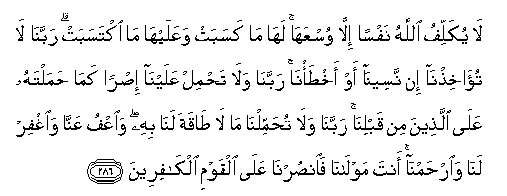
The last 2 verses of Surah Al-Baqarah

In the name of Allah, most Gracious, most Merciful.

The Prophet (Sallallahu ‘Alaihi Wa Sallam) said, “If one recites the last two Verses of Surat-al-Baqara at night, it is sufficient for him (for that night).”


It is reported on the authority of ‘Ali (RA) that he said:

“I do not consider it fitting for anyone who has understood Islam to sleep (at night) until he has recited Ayat Al- Kursi-and the ending of Surat Al-Baqarah, for they are a gift to your Prophet (SAW) from the treasure which lies beneath the Throne.” (Narrated by Ibn Mardawaih)

Translation: The Messenger believeth in what hath been revealed to him from his Lord, as do the men of faith. Each one (of them) believeth in Allah, His angels, His books, and His messengers. “We make no distinction (they say) between one and another of His messengers.” And they say: “We hear, and we obey: (We seek) Thy forgiveness, our Lord, and to Thee is the end of all journeys.”

Translation: On no soul doth Allah Place a burden greater than it can bear. It gets every good that it earns, and it suffers every ill that it earns. (Pray:) “Our Lord! Condemn us not if we forget or fall into error; our Lord! Lay not on us a burden Like that which Thou didst lay on those before us; Our Lord! Lay not on us a burden greater than we have strength to bear. Blot out our sins, and grant us forgiveness. Have mercy on us. Thou art our Protector; Help us against those who stand against faith.”

These 2 verses are often recited in Prayer and are fairly easy to memorize. Recite them every night and familiarize yourself with the translation. There is great merit in the recitation of these verses and we can all benefit from them. The last verse is also a supplication to Allah and Insha Allah, by reciting these verses regularly, our prayer will also be accepted.

May Allah pardon our sins and grant us the strength to bear our burdens. Ameen.

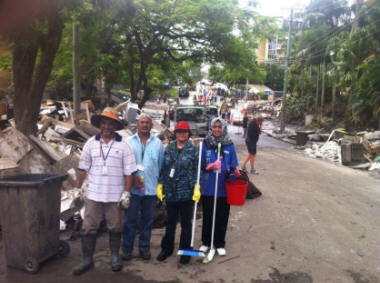
Lending a helping hand in QLD, Australia

In the name of Allah, most Gracious, most Merciful.

I’d like to congratulate and acknowledge the efforts of the Muslim Volunteers who assisted with the QLD Flood Crisis. I pray that you are rewarded in this world and in the hereafter Insha Allah.

Below is a letter received from a victim of the recent floods.

_____________________________________

Thank you so much, we went without food etc. for 3 days and eventually got picked up and were at Lowood Evacuation Centre when you delivered your bundles of kindness….we were home again and after a few days SES came to help hose mud out of sheds….they also brought out one of your green bags which was very much appreciated.

I was so impressed that it was a brand new face washer not to mention the brand new toothbrushes and the amount of thought put into the contents.

If we can return your kindness in any way please let us know. My 6yr old son goes to West Moreton Anglican College…maybe your priest could talk to the chaplain and give a talk on Muslim spirituality and join in chapel one morning.

I am technically Church of England but I don’t know much about religion. With all the hostility in the world it is a wonderful thing that your faith has done for the flood victims.

I know my family will never forget your kindness and the effort you went to for us.

Thank you with all my heart

Name Withheld

_____________________________________

This is a true form of Dawah and an excellent display of Islam in Queensland. I hope we hear of many stories like this one, Queensland is not short of natural disasters this year, so lets take advantage of this and spread Islam by being good Muslims.


Lending a helping hand!

In the name of Allah, most Gracious, most Merciful.

____________________________________

To help a Muslim in some important work and to do it for his sake or to remove his troubles and worries is an act which has been promised much reward by the Prophet. Abdullah bin Omar said that our Holy Prophet said, “’One who helps someone in his need, Allah helps him in his work, and one who removes any worry or trouble of any Muslim, Allah, in return, removes anyone of his worries on the Day of Judgment’. (Abu Daud, Kilab-al-Adab, Bad-al-Muvakhat)

Showing someone the way, sharing someone’s load or helping him with it, and all other acts of public service are included in the acts defined by this Hadith.  “Those who help others are truly much blessed,” as the Hadith says, “Best people are those who are useful to others.”

Hence all occasions of service, big or small, must be sought for; this increases one’s merits. If someone is a victim of tyranny, it is the duty of every Muslim to save him from it.

A Hadith tells us that the  Prophet Muhammad (S.A.W) said “A Muslim is the brother of another Muslim”, and “A brother does not leave his brother helpless nor does he lie to him nor yet makes false promises, nor treats him with cruelty.” (Tirmidhi: AI Birr wa-al- Silah)

Another Hadith states that, “If a Muslim is being insulted and degraded and his honour besmirched somewhere and another Muslim leaves him helpless, Allah would leave the latter helpless on occasions when he would need help. And if any Muslim helps him in when he is insulted and degraded, Allah shall help him when he would need help” (Abu Da’ud: Adab)

Helping a Muslim includes appropriate refutal of any wrong charges or insinuations levelled against another Muslim. Abu Darda’ report that our Holy Prophet has said, “One who defends the honour of his brother, Allah keeps the fire of hell away from his face on the Day of Judgment.” (Tirmidhi: al Birr wa al Silah, Chapter 20) *

____________________________________

* Above post written and researched by a friend and fellow brother in Islam – May Allah reward him.

In the wake of the current crisis in Egypt and the ongoing struggle for Palestine, it is important to understand that as Muslims and as Human Beings, we have certain rights and obligations towards each other.  Remember this when you next see someone in need and if you can assist, do so with sincerity and for no reason but for the abovementioned Hadith. It is important to remind ourselves of such sayings and Hadith so if we are given the opportunity to assist or lend a helping hand, we do so for the right reasons, with the right intentions and Insha Allah we’ll be rewarded.

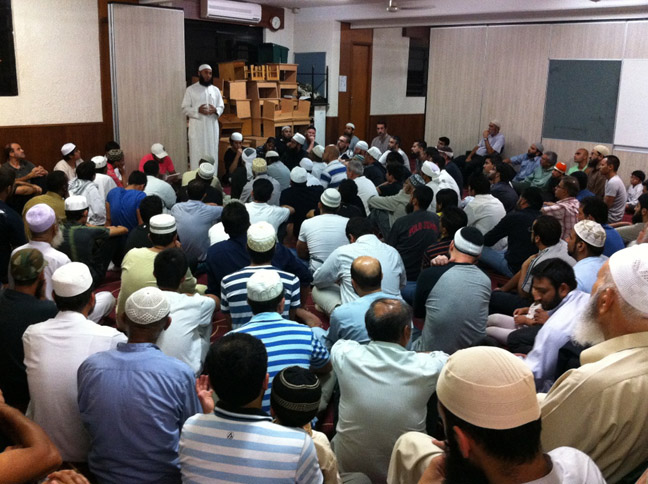
Following the recent flood crisis in Queensland, an Imam urged his congregation to extend the Muslim brotherhood to the people of Queensland. He emphasised the need and the duty for  Muslims to assist the broader community especially at times of crisis. I believe this is one of the greatest forms of Dawah and is an effective way of displaying our Faith.

I would like to emphasise the principle in the above Hadith and extend it to both, Muslims and non-Muslims. We engage with members of various faiths and beliefs on a daily basis and our religion is on display and under scrutiny 24/7. Islam teaches peace, love, respect and understanding and does not limit it to Muslims only. Sometimes lending a helping hand could make the difference between a Muslim and non-Muslim.

I hope we can implement this in our daily routine, spare a thought for your neighbour, your colleague, the guy on the street or the old lady at the shopping centre. Even the smallest of actions could have ever-lasting effects.

May Allah assist us and allow us the opportunity to assist others.


An Islamic adaptation of the Sabbath…

In the name of Allah, most gracious, most merciful.

I recently became aware of the religious beliefs and rituals of some of the people I work with and I found the idea of the Sabbath very intriguing. Most people know the Sabbath to be the day Jews are forbidden to work,  however from  a Jewish perspective it is more than just rules and restriction.  As Tracey R. Rich puts it, “”it is a precious gift from God, a day of great joy eagerly awaited throughout the week, a time when we can set aside all of our weekday concerns and devote ourselves to higher pursuits.” According to the Torah,  the purpose of Sabbath observance is to remind the Hebrew people of two very important events in history: the creation of the world (Ex. 20:11) and the deliverance from slavery in Egypt (Deut. 5:15). Both highlight the central Jewish religious belief: that there is one, powerful creator God who cares for his people.

People of different religions and faiths observe the Sabbath in different ways and for different reasons. For members of the Church of Jesus Christ of Latter-day Saints or Mormons, Sunday is a quiet day for church attendance, rest from worldly pursuits, and spiritual reflection. I work very closely with members of the Mormon Church and their beliefs and spirituality have truly inspired me.

While different religions have different interpretations of the Sabbath, the principle remains the same and I believe the principle is Islamic at its core.

Examples of appropriate Sabbath activities include:

  • Attending Church
  • Prayer
  • Reflection & Contemplation
  • Studying scriptures
  • Spending time with family
  • Visiting the sick
  • Physical rest

As a Muslim, I was amazed at the spiritual devotion of the people who observe the Sabbath and I questioned my own devotion and spirituality. I began contemplating an Islamic adaptation the Sabbath.

Based on the principles and teachings of Islam and drawing inspiration from the Jewish and Mormon faiths, I believe we can increase our spirituality and our awareness of God by setting aside Sabbath-like periods in our lives.

Depending on the level of your faith and your circumstances this could be implemented daily, weekly or however you see fit. The frequency and duration is up to the individual, but the intention should be for the pleasure of Allah and to elevate your spirituality.

Examples of appropriate activities from an Islamic perspective would include:

  • Reading Quran
  • Prayer/Dua
  • Reading/Learning Hadith
  • Optional (Nafl)  Prayers
  • Spending time with the family (NO TV)
  • Visiting the sick
  • Fasting
  • Dhikr & the remembrance of Allah
  • Visiting the Mosque (besides the daily prayers)

The key is to avoid all worldly matters and take part in activities that will enhance your spirituality and create a better awareness and understanding of your faith.

Some may argue that we should be practising these activities all the time anyway, even if we do, there can be no harm in setting aside time each day or each week in devotion to your Lord.

I hope we can all benefit from this, set aside some time each day or each week to remove yourself from worldly matters and spend some time contemplating and reflecting on your faith. Insha Allah we will become better Muslims and will better appreciate the bounties of our Lord.

” O ye who believes remember Allah very often and glorify Him morning and evening.” (33:41-2)

” Then do ye remember Me I will remember you.” (2-152)

Dead Sea Seacret… Religious Perspective!

The Dead Sea

I was quite impressed after sampling a treatment from a “Seacret” store in the mall the other day and found that the source of these treatments was the Dead Sea. I could recall a few childhood stories about the Dead Sea which made me question the permissibility and appropriateness of using such treatments. This is what I found:

According to Islamic and Biblical traditions, the Dead Sea is the site of the ancient city of Sodom, home of the Prophet Lut (Lot), peace be upon him.

Prophet Lut (A.S.), after consulting with Prophet Ibrahim (Abraham) (A.S.) left Misr and traversed towards the eastern part of Urdun (Jordan), a place called Sodom or Sadoom. The purpose of his migration was to propagate the teachings of Ibrahim (A.S.) amongst the inhabitants of Sodom, a village situated in the area where the Dead Sea is presently located.

The people of surrounding areas firmly believe that the region in which the Dead Sea is found was once occupied by the people of Sodom. This nation directly rejected the message which Prophet Lut (A.S.) presented to them, due to which they were punished most severely, as described by Allah, “So at day break a mighty cry seized them. Then We turned the localities upside down and We showered upon them rocks of baked clay. In this (incident) there are indeed multiple signs for the people who discern.” (Surah Hijr, Verse 73)

The earth on which they lived was lifted into the sky and then caused to come crashing down approximately 400 meters below the earth. As a result, this area was submerged, and is now known as the Dead Sea. (Qasas ul Qur’an, Vol. 1, Page 257, Mukhtasar Tafseer Ibn Katheer, Vol. 2, Page 312) According to scientists, the area is covered in large deposits of sulphur. For this reason, no life in the form of animals or plants is to be found there and the region stands as a symbol of destruction.

It has been reported by Abdullah ibn Umar (R.A.), that when Prophet Muhammad (S.A.W.) descended at the place of Hijr (the region where the nations of ‘Aad and Thamud once resided) during the battle of Tabuk, he (S.A.W.) commanded the Sahabah (companions) not to drink from the accursed place. The Sahabah informed the Prophet (S.A.W.) that they had already utilized the water for making dough and drinking. The Prophet (S.A.W.) instructed them to discard the dough and water.

While commenting on this Hadith, Imam Hajar Al-Asqalani (R.H.) outlines that the Hadith clearly teaches us that, it is Makrooh (impermissible) to use the water found in the area of Hijr. He further states, that the same ruling will apply to other accursed places.

The Prophet Muhammad (S.A.W), reportedly tried to dissuade people from visiting the sites of God’s punishment: “Do not enter the place of those who were unjust to themselves, unless you are weeping, lest you should suffer the same punishment as was inflicted upon them.”

The Qur’an describes that the site of this punishment has been left as a sign for those who follow: “Surely! In this are signs for those who understand. And verily, they (the cities) are right on the high-road. Surely! Therein is indeed a sign for the believers.” (Qur’an 15:75-77)

In light of the above narrations, revelations and explanations, we can conclude that the use of products derived from the Dead Sea is inappropriate and should be avoided. I hope we can all benefit from this Insha Allah. May Allah strengthen our faith and make us among those who guide and whom are guided.

Ameen.

Assalaamu Alaikum!

Rain: Neglected blessing!

In the name of Allah, most Gracious, most Merciful.

I found myself questioning the wet weather this holiday season and was reminded of how much we neglect this blessing from Allah. How often do we even acknowledge  this bounty? Every favour from our Lord is indeed a bounty and deserves recognition and gratitude.

“And He who sends down (from time to time) water from the sky in due measure, and We raise to life therewith a land that is dead. Even so will you be raised (from the dead).” (Surat az -Zukhruf, 11)

“It is Allah Who sends the Winds, and they raise the Clouds: then does He spread them in the sky as He wills, and break them into fragments, until you see rain-drops issue from the midst thereof: then when He has made them reach such of his servants as He wills behold, they do rejoice!”

“We send down pure water from the sky. That with it We may give life to a dead land, and slake the thirst of things We have created,- cattle and men in great numbers.” (Surat al – Furqan, 48- 49)

“And We send down from the sky rain chartered with blessing, and We produce therewith gardens and grain for harvests.” (Surah Qaf, 9 )

Thank Allah for the bounties around you, despite the inconvenience at times, they are gifts from the Almighty. Being grateful for Allah’s bounties is a form of Dhikr, if you constantly thank Allah for his blessings, you will always remember Allah… “Therefore remember Me. I will remember you. Be grateful to Me and never show Me ingratitude” – Al-Baqarah 2:152.

May we always be grateful for the bounties & blessings from Allah!

Ameen!

Backbiting & Gossip…

I read an interesting article on backbiting and gossip recently which I’d like to share as a reminder to us all. It is something we can all relate to and unfortunately something we very often participate in. The issue is not the nature or severity of the sin, I believe the real issue lies in our failure to acknowledge and recognise the fact that backbiting and gossiping are sinful acts. The recognition of certain acts as sinful or haraam is embedded in our minds from childhood and are therefore easier to reflect upon and acknowledge even as we grow up, however, the acts that are overlooked in our early years can easily be overlooked and even justified as we grow up. Unfortunately, backbiting and gossip are easily overlooked and pose a greater threat to us as we develop and grow. I hope this article serves as a reminder to us of the severity of these sins and also allow us to recognise and acknowledge them as sins so we are better able to avoid and resist them.

___________________________________________________________

Many gatherings produce nothing but gossip about other Muslims and slander of their honour. This is something which Allah has forbidden His slaves, and has drawn the most repulsive analogy to put them off. He says (interpretation of the meaning): “. . . neither backbite one another. Would one of you like to eat the flesh of his dead brother? You would hate it . . .” [al-Hujuraat 49:12]

The Prophet (peace and blessings of Allah be upon him) explained the meaning of this aayah. He said: “Do you know what gheebah (gossip or backbiting) is?” They said, “Allah and His Messenger know best.” He said: “To say something about your brother that he does not want to be said.” He was asked, “What do you think if what is said about him is true?” He said, “If what you say about him is true, this is backbiting, and if what you say about him is not true, this is a lie.” (Reported by Muslim, 4/2001). Gossip or backbiting means saying something about a Muslim which may be true but which he does not like to hear spoken, whether it be about his physical appearance, his adherence to religion, his worldly affairs, his self, his behaviour or his character. There are many forms of gossip, including talking about a person’s faults and imitating him to make fun of him. People take the matter of gheebah very lightly, although it is very serious in the sight of Allah, as is indicated by the words of the Prophet (peace and blessings of Allah be upon him): “There are seventy-two forms of riba, the least of which is as bad as a man having intercourse with his own mother, and the worst of which is when a man slanders the honour of his brother.” (Silsilah al-Saheeh, 1871).Whoever is present in a gathering where gossip takes place should “forbid what is evil” and defend his absent brother. The Prophet (peace and blessings of Allah be upon him) encouraged us to do this when he said: “Whoever defends the honour of his Muslim brother, Allah will protect his face from the Fire on the Day of Resurrection.” (Reported by Ahmad, 6/450; see also Saheeh al-Jaami’, 6238).  

Some people go about repeating the words of others to cause trouble between people; this is one of the greatest causes of broken relations and stirring up feelings of hatred among people. Allah condemned the one who does this (interpretation of the meaning): “And obey not everyone who swears much, – and is considered worthless, a slanderer, going about with calumnies.” [al-Qalam 68:10-11]Hudhayfah reported that the Prophet (peace and blessings of Allah be upon him) said: “No eavesdropper will enter Paradise.” (Reported by al-Bukhaari, see al-Fath, 10/472; “eavesdropper” here refers to a person who eavesdrops on others without their knowing, then goes and tells others what he has heard)

Ibn ‘Abbaas said: “The Prophet (peace and blessings of Allah be upon him) passed by one of the gardens of Madeenah, and heard the sound of two people being punished in their graves. The Prophet (peace and blessings of Allah be upon him) said: “They are being punished, but they are not being punished for any major sin; one of them used never to clean himself properly after urinating, and the other used to spread malicious slander . . .” (Reported by al-Bukhaari; see Fath al-Baari, 1/317).

___________________________________________________________

I hope this article has highlighted and reiterated the severity and consequences of backbiting & gossip. My intention was not to scare or depress anyone, but rather to serve as a reminder and hopefully a deterrent towards these sinful acts. It is important to teach our children about theses acts so they grow and develop with the acknowledgement and recognition of these acts as sinful. Don’t promote backbiting and gossip by asking children about other kids at school and don’t backbite or gossip about others in the presence of your kids. What we learn as children and the habits we develop as kids will be reflected in our actions as adults, we need to encourage an Islamic upbringing in order to promote an Islamic lifestyle. I think a good start would be to stop backbiting and gossiping ourselves and Insha Allah the people around us will follow.

Thanks for reading, may Allah make us among those who are guided and among those who guide. Ameen.

Cash Fardh vs. Credit Fardh

In the name of Allah, most Gracious, most Merciful.

I came across the idea of Cash and Credit Fardh a little while ago during a lecture about the teaching methods of Prophet Muhammad (S.A.W) and it has served as a good reminder to me ever since. I’ve found that even the simplest of principles are easily forgotten and are often neglected. The cash and credit analogy puts things into perspective and is something most of us would be familiar with. I hope you can benefit from it too.

A cash fardh is a compulsory/obligatory act that is prescribed at a specific time and falls due immediately while a credit fardh is a compulsory/obligatory act that is prescribed at a specific time however, due to certain circumstances, can fall due at a later date. In essence, it becomes a credit which needs to be paid back. For example, if a person meets the requirements to skip r miss a fast during Ramadhan (health reasons, etc.) the fast, though fardh, become a credit fardh which is due after Ramadhan, obviously sooner rather than later. Until the person completes the fast it is a credit fardh owed and represents a liability or a debt.

An example of a cash fardh is the 5 daily prayers and the Fajr prayer in particular. The Morning Prayer is prescribed at a certain time and the obligation must be fulfilled immediately. If for some reason you sleep in and aren’t able to pray within the prescribed time, the prayer remains a cash fardh which needs to be fulfilled as soon as possible. So if you miss Fajr, for whatever reason, you must pray as soon as you are able to without delaying any further. A cash fardh cannot be converted into a credit fardh, so you should avoid putting off the Fajr prayer until the Zohr prayer or any other time. If you maintain the 5 prayers on a cash basis, provided you make the right intention, Allah will guide you and you will easily fulfil your daily obligations. If you fall short on occasion, make up for it immediately and pray for Allah’s guidance – Allah is oft forgiving and most merciful.

If we divide our spiritual obligations into cash and credit terms, it becomes easier to recognize and prioritise certain acts. The key here is to highlight the cash fardh as the highest priority. Next time you miss a prayer, for whatever reason or excuse, think about cash vs. credit fardh and fulfil your duties accordingly. People work hard to avoid financial debt; we need to work harder to avoid spiritual debt.

May Allah guide us and allow us to fulfil our spiritual obligations punctually and sincerely… Ameen!

Stolen time…

In the name of Allah, most Gracious, most Merciful.

I was inspired by the following article titled “Shaytan called a worldwide convention”:

_______________

In his opening address to his evil Jinns, he said, “We can’t keep the Believers from going to Masjids. We can’t keep them from reading their Qur`an and knowing the truth. We can’t even keep them from forming an intimate, abiding relationship experience with Allah”. Once they gain that connection with Allah, our power over them is broken. So let them go to their Masjids; let them have their conservative lifestyles, but steal their time, so they can’t gain that relationship with Allah.

This is what I want you to do Jinns. Distract them from gaining hold of their Lord and maintaining that vital connection throughout their day! “How shall we do this?” shouted his Jinns. “Keep them busy in the non essentials of life and invent innumerable schemes to occupy their minds,” he answered. “Tempt them to spend, spend, spend, and borrow, borrow, borrow. Persuade the wives to go to work for long hours and the husbands to work 6-7days each week, 10-12 hours a day, so they can afford their empty lifestyles. Keep them from spending time with their children. As their family fragments, soon, their home will offer no escape from the pressures of work!” “Over-stimulate their minds so that they cannot hear that still, small voice. Entice them to play the radio or cassette player whenever they drive, to keep the TV, VCR, CDs and their PCs going constantly in their home and see to it that every store and restaurant in the world plays non-Qur`anic recitation constantly. This will jam their minds and break that union with Allah.” “Fill the coffee tables with magazines and newspapers. Pound their minds with the news 24 hours a day. Invade their driving moments with billboards. Flood their mailboxes with junk mail, mail order catalogs, sweepstakes, and every kind of newsletter and promotional offering free products, services and false hopes. Keep skinny, beautiful models on the magazines so their husbands will believe that external beauty is what’s important, and they’ll become dissatisfied with their wives. That will fragment those families quickly!” “Even in their recreation, let them be excessive. Have them return from their recreation exhausted, disquieted, and unprepared for the coming week. Don’t let them go out in nature to reflect on Allah’s wonders. Send them to amusement parks, sporting events, concerts and movies instead. Keep them busy, busy, and busy! And when they meet for spiritual fellowship, involve them in gossip and small talk so that they leave with troubled consciences and unsettled emotions. Go ahead, let them be involved in soul winning; but crowd their lives with so many good causes they have no time to seek power from Allah.” “Soon they will be working in their own strength, sacrificing their health and family for the good of the cause. It will work! It will work!” It was quite a convention. The evil Jinns went eagerly to their assignments causing Believers everywhere to get busier and more rushed, going here and there.

_______________

If you’re chasing your tail from morning to evening, waking up early, working late, not sleeping enough, studying hard and pursuing all the luxuries of this world, how much time do you devote towards you Lord? Apart from the 5 daily prayers, (I’m assuming we all manage that much at least) are we able to spare a few minutes everyday to read Quran? 5 minutes a day to read a Hadith? 5 minutes at the end of each day to thank Allah for his bounties? 5 minutes each morning to pray for guidance? A few minutes after each prayer for the remembrance of our Lord?

Why don’t we have time? Why can’t we spare a few minutes of our lives to remember and thank our Lord? From a young age we are moulded to pursue this lifestyle. Go to school so you can study, go to uni so you can get a job, get a job so you can make money, make more money so you can afford the house, the car, the holidays, the gadgets… and once you’re in the system, it ain’t easy to unplug. We are all guilty of it, unfortunately the lifestyle many of us pursue is not conducive to our Islamic way of life, however I don’t believe they are completely incompatible.

As I mentioned in “The jar of life”- Sometimes the less important things in life can distract us, filling up our time and keeping us away from what really matters. If we get our priorities in order, we can fit everything in. The  key is to prioritize, do what’s most important and Insha Allah you will see Barakah in your time and Barakah in your life. As a Muslim, prioritize your faith, be punctual and sincere in your prayers, devote some time each day to your Lord. Spend time with your family and do charitable work, fulfil your religious obligations and seek knowledge in your Faith. Your career, no matter how important it may be, must come after your religion and family. You will find that if you are able to maintain this balance, your work, studies and other responsibilities will find a way to work around your faith and Insha Allah you will succeed in them too.

A few things I’ve learnt to aid in better time management and pursuing a more Islamic way of life:

  • wake up early and pray Fajr
  • read Quran, exercise, study, etc, early in the morning – (stay up after Fajr)
  • stay focussed and set targets
  • make notes and use a diary
  • work hardest in the first half of the day
  • take breaks and pray on time
  • eat regularly, eat healthy
  • take time out to de-stress
  • skip the music – listen to Islamic lectures or nasheeds
  • avoid unnecessary distractions (facebook, twitter, aimless surfing) – there’s a time and place for this!
  • remember Allah and reflect upon his bounties (even the small ones)
  • when doing for others, make a sincere intention – sometimes the only difference between a random act and a spiritual act is the intention
  • make time for your family
  • avoid gossip
  • thank Allah for his provisions
  • read a book (Quran, Hadith, Islamic Stories, etc.) No good deed will go unnoticed
  • avoid excessive tv, movies, gaming
  • pray on time and preferably at the Mosque
  • renew your faith by visiting the Mosque daily
  • if you watch tv, don’t let it be the last thing you do before bed
  • make a sincere intention to wake up for Fajr
  • sleep early

I ask Allah to guide us and allow us to pursue an Islamic way of life. Its harder to achieve this in today’s secular environment but if we are successful, the reward will be greater… Insha Allah!

Muhammad al-Shareef has an inspiring lecture on time management which is available for download at http://www.kalamullah.com/muhammad-alshareef.html

I leave you with a quote by Imam Anwar al-Awlaki… “be mindful of Allah and Allah will be mindful of you”.